Hola, dear Paella Lover friends!
Every time I stand before the wide pan, spoon in hand, I feel like I’m stepping into history. Paella is not only a dish, it’s a language, a tradition, and a gathering point for families and friends. It carries the smell of saffron, the hiss of oil, the laughter of neighbours, and sometimes even the small arguments over whether rabbit belongs, or if rosemary is “essential.”
So today, I thought: why not wander through the Paella A to Z? An alphabetical journey, each letter unlocking a different part of this dish’s universe. From rice to rituals, pans to parties, history to festivals, each section holds a piece of paella’s story.
This isn’t a recipe. It’s a walk through memories, facts, flavours, and little secrets. Think of it as sitting by the fire, glass of wine in hand, while I talk you through everything I’ve learned, lived, and loved about paella.
B – Bomba Rice
C – Calasparra Rice
D – Duck Paella
E – Etymology of “Paella”
F – Fideuà
G – Garrofón Beans
H – History of Paella
I – Ingredients of Paella Valènciana
J – José María Pisa
K – Kitchen Kit
L – Leña or Lenya in Valèncian (wood)
M – Mallorquina Paella
N – Never Stir the Rice
O – Original Paella Pan
P – Paelleros (Paella Cooks)
Q – Quantity of Rice per Person
R – Rosemary
S – Socarrat
T – Types of Paella
U – Unidad (Unity)
V – Vegetable Paella
W – Water & Broth Ratio
X – Xirivella Paella Celebrations
Y – Yema (Egg Yolk)
Z – Zoco (Marketplace)
A – Arroz (Rice)
No rice, no paella. And not just any rice, but short-grain varieties that can soak up stock like a sponge while staying intact. Bomba, Senia, Albufera; these are the names you must know!
Each brings a personality:
- Bomba is patient and firm.
- Senia is quick and tender.
- Albufera balances both qualities.
In València, we don’t argue over “seafood or chicken” first. We argue over rice. That’s how central it is. Rice is the soul of paella, the canvas for every other ingredient. If you’d like to dive deeper into which rice truly works best, I’ve written a full guide here: What is the Best Rice for Paella?.
B – Bomba Rice
Bomba is the world’s most known paella rice. Its grains swell width wise, never bursting, never turning to mush. It can absorb up to six times its weight in liquid, which makes it almost foolproof for big pans.
Yes, it’s more expensive, but think of it as insurance. With Bomba, you don’t just make paella; you make paella with confidence!
C – Calasparra Rice
From Murcia, grown in cold mountain waters, Calasparra rice is a little larger, creamier, and has a unique bite. It takes its time, sometimes up to 25 minutes, but paella has never been a fast dish.
Cooking with Calasparra is a lesson in patience and reward.
D – Duck Paella

Autumn and winter sometimes call for duck. Rich, fatty, and perfect when paired with mushrooms or foie gras, duck paella is hearty and memorable.
It’s not “the classic,” but it shows paella’s ability to adapt to seasons and regions, making it my 3rd favourite paella rice!
E – Etymology of “Paella”
“Paella” doesn’t mean the food. It means the pan. From the Latin patella, a shallow pan, the word travelled through Catalan into Valèncian, where it became ours.
Only later did “paella” mean the dish itself. I explored this in detail in What Does Paella Mean in Spanish?.
To me personally, PAELLA means the gathering of people around this iconic dish; memories of València, where every Sunday we update about the latest, share the weekly happenings or simply “for the sake of paella”.
F – Fideuà

A Paella-cousin born by accident in Gandía. There are several storied around it, but this is the most known: a fisherman ran out of rice while fishing at sea and poured noodles into the pan instead. What came out was fideuà: vermicelli pasta soaking in saffron broth, crowned with seafood, often served with garlicky aioli.
It’s not paella, but it’s part of the family. Same pan, same fire, same spirit. In fact, fideuà has grown so beloved that it has its own competition in Gandía, attracting chefs from across Spain.
G – Garrofón Beans

Those big, flat white beans are more than filler; they’re identity. Without them, paella Valènciana feels incomplete. Creamy, almost buttery, they add depth to the stock and body to the rice.
Grown in València and rare outside Spain, garrofón connects paella to its birthplace: the land around the Albufera lagoon.
H – History of Paella
Paella was not born in restaurants, but in the countryside. Farmers cooked rice with whatever they had: vegetables, rabbit, sometimes snails and other ingredients as many as paella cooks in the region. It was food of necessity that grew into food of pride.
I told this story in Origins of Spanish Paella. For me, remembering this history keeps paella grounded.
I – Ingredients of Paella Valènciana
The canon: rice, chicken, rabbit, garrofón, flat green beans, tomato, saffron, olive oil, water, and salt.
In my family, we add garlic, rosemary, paprika and artichoke when possible. These little touches make every family’s paella unique.
J – José María Pisa
Historian and gastronome, José María Pisa helped record paella’s story. His Biografía de la Paella (2011) is a monument of research; tracing myths, recipes, and origins. Without his work, much of paella’s written past might be lost.
If you’re curious, you can find the book at Spanish specialty retailers like Librería Emilio Cobos: Biografía de la Paella.
K – Kitchen Kit
You cannot make paella in a saucepan. You need the right tools: a wide, shallow pan (paella or caldero in Valèncian, never paellera), long spoons, a gas burner or wood fire.
I wrote a full guide in The Essential Cookware for Paella.
L – Leña or Lenya in Valèncian (wood)
Firewood is the primordial soul of an authentic paella, the element that elevates the rice to a higher sensory dimension. Orange wood gently perfumes the flames with subtle citrus notes, while vine wood—intense and aromatic—is ideal for simmering the broth and achieving a deep, refined socarrat. Its lively, noble combustion allows the flame to be controlled with almost ritual precision. Cooking over wood is not merely a technique; it is an ancestral spectacle where fire, smoke, and rice come together in perfect harmony.
M – Mallorquina Paella
On Mallorca, paella takes on an island accent. Sobrasada, the paprika-rich cured sausage, melts into the rice, giving it a smoky sweetness. Local vegetables and seafood round it out.
It’s different, yes. But that’s the beauty: paella bends to its land. I explored this twist in Paella Mallorquina.
N – Never Stir the Rice
Once the rice is spread evenly, leave it alone. In paella, rice remains whole and loose. Stirring turns rice into a creamy and mushy dish: we don’t want risotto! To get socarrat; the prized crust, you must let the rice cook undisturbed.
O – Original Paella Pan
The pan is not just a vessel, it’s an identity. Wide, shallow, thin-bottomed, designed so rice cooks evenly and liquid evaporates quickly.
I compared the different types; polished steel, enamel, stainless, in Types of Paella Pan, and shared care tips in How to Clean and Maintain Paellas.
P – Paelleros (Paella Cooks)

In València, the word paellero means more than “the cook.” It’s a badge of honour. Families often have one person; father, uncle, or grandmother who carries the responsibility of paella. They know how much wood to use, how to judge the broth by colour alone, when to stop stirring, when to let silence and fire do the work.
Being the paellero isn’t about ego; it’s about trust. At Sunday gatherings, while everyone else drinks wine and chats, the paellero tends the fire, watches the bubbles, listens to the rice. And when the paella is finally carried to the table, it’s not just food being served, it’s their reputation. Some people spend decades earning the title. Others inherit it, passed down like a sacred spoon. Without paelleros, paella would never have become a ritual.
Q – Quantity of Rice per Person
This is the question I’m asked most often: “How much rice do I need?”
The rule: 100 g per person. For 30 people, 3 kg. For big eaters, maybe 120 g. For heavier proteins, a little less.
It’s not maths; it’s hospitality. Better too much than too little. I break this down further in How to Host a Paella Party for 20 to 30 People.
R – Rosemary
A sprig of rosemary laid on top during cooking perfumes the entire dish. It’s the scent of the Valèncian countryside; wild, green, earthy. Some deny it belongs, but I say paella is memory, and rosemary is one of mine.
S – Socarrat

The golden, caramelised crust at the bottom of the pan. The crown jewel! To get it, you need patience, steady heat, and the discipline to resist stirring.
In València, we fight over socarrat, not metaphorically, but literally. Spoons clash, elbows jab, and everyone wants the darkest, crunchiest bit.
Socarrat is more than flavour, it’s reward. It tells you the rice was cooked properly, that the heat was steady, that the cook trusted time to do its work. It is the signature of a well-made paella, the final applause after the symphony of cooking.
T – Types of Paella
There’s no single paella. Valènciana (chicken and rabbit). Marisco (seafood). Mixta (both). Vegetariana. Fideuà (noodles). Even baked rice in clay pots, little known outside València.
Each tells a different story of place and people. Paella is not rigid; it’s alive, evolving, adapting to its land.
U – Unidad (Unity)
One pan. Everyone gathered. Each eating from their triangle. No one gets more, no one less. Paella is democracy in food form.
V – Vegetable Paella
Vegetable paella is not an afterthought. In spring, artichokes. In summer, peppers and beans. In autumn, mushrooms. Cooked with the same care as any meat or seafood version, it proves paella’s power: to take the simplest produce and turn it into a feast.
W – Water & Broth Ratio
Rice and liquid must be in balance. Too much broth: mush. Too little: burnt. The sweet spot is usually 2.5–3 parts broth per 1 part rice. Remember: always depending on the type of rice!
I explained this in detail in 6 Most Common Paella Mistakes.
X – Xirivella Paella Celebrations
Each September, Xirivella becomes one big paella party. Families gather in squares, setting up pans, sharing ingredients. It’s not about chefs or restaurants, it’s about people.
These fiestas remind us what paella truly is: a dish of community. Explore their festivity programme here: Xirivella Festes Patronals.
Y – Yema (Egg Yolk)
Not common in València, but in some regions, a soft yolk is cracked over the rice, blending with saffron and stock. It’s indulgent, unusual, and shows how creativity sneaks into tradition. There is a so-called “arrós en costra” in which some eggs are beaten over the surface and then the paella goes into the oven. A crust is created and people love it.
Z – Zoco (Marketplace)
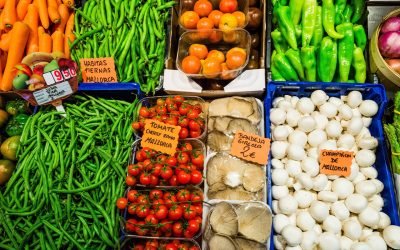
Every paella begins long before the pan touches the fire. It begins in the zoco, the marketplace. In València, markets are living theatres: voices rise and fall, fishmongers chant, saffron is measured in grams as if it were treasure. You walk through the stalls and it feels like the dish is assembling itself around you.
Here, you find the freshest prawns, still glistening with sea spray. Garrofón beans, fat and pale, waiting to melt into the broth. Tomatoes so ripe they almost collapse in your hand, destined for sofrito. And above all, rice; sacks of Bomba, Senia, or Albufera, each with its own devotees.
Shopping in a supermarket may give you the ingredients, but shopping in a market gives you the story. You talk to growers, ask the butcher about the right rabbit cut, get advice from the vendor who has seen three generations of paelleros in your family. That connection is as much a part of paella as saffron or stock.
When I buy ingredients at the market, I don’t just fill a basket. I gather pieces of tradition, carrying them back to my kitchen. Without the zoco, paella would lose half its flavour, the human one.
Final Thoughts
And there you have it, paella from A to Z. Each letter a flavour, a story, a tradition. Together, they remind us that paella is not just rice and stock, but history, community, debate, laughter, and the occasional fight over socarrat.
May this alphabet inspire you to cook, to share, to taste and above all, to gather.
Until next time, keep the pan hot, the saffron flowing, and the conversations lively.
HAPPY PAELLA!!
— Guillermo Bermell